Everyone says "Don't go to the casino."
They're right. But if you're going anyway...
The math is against you. You will lose. But some games are less terrible than others. Some situations make casino gambling comparable to other entertainment spending. This is the honest guide to when (and how) to minimize the damage.
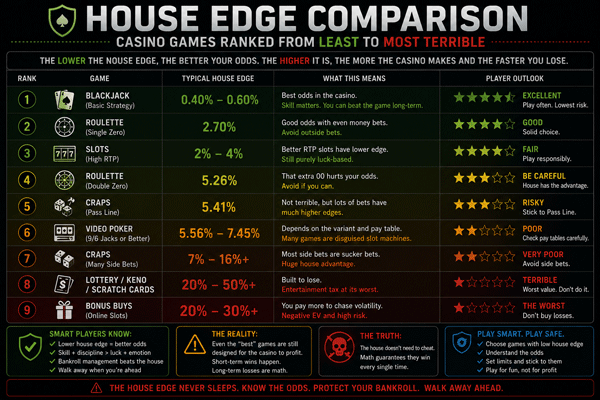
- Slots (8-10% average) - no strategy, addictive design, $50-100/hour loss. American Roulette (5.26%) - double-zero trap; play European instead. Lottery/scratch-offs (30-50%) - worst odds on earth, pure tax on hope. Keno (25-40%) - casino's fastest money printer, 50x worse than blackjack. Sports betting at casino (4-5%) - book takes a cut; you're fighting the house.
- ABSOLUTE RULES: never gamble with essential money. Never use credit cards. Never borrow. Never re-deposit after loss limit. Never chase losses. Never increase bets to "win it back."
- If you have addiction history → STOP. If chasing losses → wait 2 weeks minimum. If using essential money → never. If lying → STOP and talk to someone. If tolerance increasing → contact Gamblers Anonymous (1-800-522-4700).
- If you're going to gamble: use entertainment budget only. Set strict loss limit ($50-100) and LEAVE when hit. Play blackjack/video poker/craps (smart bets) only. Learn the strategy. Set time limits (2-4 hours). Limit frequency (monthly or less). Be honest with your partner. Wait 2 weeks after losses. Cash only, no re-buys. Monitor monthly for addiction signs. If tolerance increasing or hiding behavior → STOP and seek help.
The Honest Hierarchy Of Casino Games
(Ranked By House Edge - How Fast You'll Lose)
When Casino Gambling Is Better Than Alternative Entertainment
The Bankroll Management Strategy
(How To Protect Yourself)
Core principle: Casino money = entertainment budget. Not rent. Not emergency fund. Not investment money.
Step-by-step:
- 1Calculate monthly entertainment budget (example: $250 after essentials + savings).
- 2Divide into sessions ($50/session × 5 sessions).
- 3Set rules: loss limit ($50), time limit (2-4 hours), win-and-quit ($50-100 profit = leave), no re-buys (cash only).
- 4Track every session. Adjust next month if over budget.
When You Should ABSOLUTELY NOT Go To A Casino
- Gambling to escape problems/stress
- Chasing losses from previous sessions
- Using essential money (bills, emergency, kids)
- Lying about gambling or losses
- Tolerance increasing (need more money/time)
- Affecting relationships (hiding, arguments, missing events)
- Sudden large losses ($1,000+ in a session)
The Psychology Of "Smart Gambling" + The Decision Flowchart
Comparisons + Real Case Studies
The Compromise Position + The Bottom Line
- History of gambling addiction/problems
- Gambling to escape stress/problems
- Chasing losses from last session
- Using essential money (bills, emergency, kids)
- Lying about gambling or losses
- Tolerance increasing (need more $ or time)
- Affecting relationships (hiding, arguments)
- Recent large losses ($1,000+ in one session)
- Entertainment budget only (can afford to lose 100%)
- Strict loss limit ($50-100) - LEAVE when hit
- Play blackjack/video poker/craps (smart bets) ONLY
- Learned basic strategy (no winging it)
- Time limit (2-4 hours max) - set alarm
- Cash only, no ATM/credit cards/re-buys
- Wait 2 weeks after any loss before returning
- Honest with partner about budget and losses
- National Council on Problem Gambling: 1-800-522-4700
- Gamblers Anonymous meetings
- NCPG Self-Assessment Tool
- Wizard of Odds (house edge database)
- Blackjack Basic Strategy Charts (printable)
- Video Poker Strategy Cards
- SAMHSA Helpline: 1-800-662-4357
- Addiction Center treatment finder
- Local mental health resources

Psychologist specialized in behavioral addictions with over 8 years of experience helping people with gambling problems in Chile.
LinkedInView profile →Disclaimer: Educational investigation into casino gambling risks and harm reduction only. Not legal, financial, medical, or addiction advice. You will lose money at the casino long-term. The math is settled. If you have gambling problems or addiction, seek professional help immediately (1-800-522-4700). Gambling involves risk of addiction and financial ruin. Consult qualified professionals for personal advice.