
Casinos Aren't Just Predatory Toward Civilians.
They're the World's Most Efficient Money Laundering Machine.
Cartel sells drugs for $500M in cash. Problem: Can't deposit $500M in a bank without getting flagged. Solution: Launder it through casinos. Cash goes in dirty, "gambling winnings" come out clean. Money is now legitimate. The casino industry DEPENDS on this. Regulators PRETEND to stop it. And LATAM governments are fucking complicit.
- METHOD 1: The Intentional Loss / Win Scheme - Dirty money enters as cash. Operator bets heavily and either intentionally loses (or wins big on rigged/favorable outcomes). A single casino can launder $10M+ per week this way for a major cartel. METHOD 2: Structuring (Smurfing) - Use 50 people each depositing $10k instead of one $500k deposit. Each gets chips, loses quickly, cashes out. $500k is now documented as many small legitimate transactions.
- The money being laundered is blood money - from drug overdoses, human trafficking, extortion, kidnapping, and cartel violence. By enabling laundering, the gambling industry directly funds more cartel operations, more production, more corruption, and more deaths. Mexico alone has seen hundreds of thousands of drug-war deaths; Brazil tens of thousands of gang-related homicides annually. A significant portion of that ecosystem is financed and sustained through casino and betting laundering channels.
- Ban large cash deposits, real-time blockchain monitoring with mandatory casino cooperation, prosecute owners for facilitating laundering, shut down offshore havens, actual AML enforcement with real budgets. All blocked because casinos and governments profit too much.
- The Gambling Industry Isn't JUST Predatory Toward Civilians. It is also one of the world's most efficient money laundering mechanisms. Governments know. Regulators know. Casinos know. Nobody stops it because casinos profit, governments collect taxes, criminals expand operations, and corrupt officials get rich. The only people who lose are the civilians whose communities are destroyed by the violence this system sustains.
Money Laundering 101. The Casino Version

The Classic 3-Step Process
STEP 1: PLACEMENT - Get dirty money into the system. Cartel operative walks into a casino with $100k+ in cash, buys chips. No questions asked because "cash is normal in casinos." Documentation is minimal or fake. Casino profits immediately from the exchange/rake.
STEP 2: LAYERING - Obscure the origin. Operator makes bets (wins or loses intentionally), moves money between accounts, jurisdictions, or cryptocurrencies. Creates fake "gambling history" to justify the cash. Paper trails become impossible to follow.
STEP 3: INTEGRATION - Money becomes "clean." Operator cashes out as winnings, wires to legitimate business accounts or shell companies. Money now appears as legitimate casino earnings and can be deposited in banks or used to buy real estate and businesses.
Why Casinos Are PERFECT For This
- Cash-heavy business: big money is normal.
- International transactions create jurisdictional confusion.
- Minimal real KYC enforcement in many jurisdictions.
- Regulatory bodies are understaffed, underfunded, or corrupt.
- Operators profit either way (they take a cut regardless of source).
- Crypto casinos: Zero traceable records, fast, irreversible.
METHOD 3: The Cryptocurrency Angle (Modern as Fuck) - Dirty cash → Crypto (often via unregulated exchanges) → Play on crypto casinos with no KYC → Win or lose (doesn't matter) → Cash out to fiat via multiple exchanges in different countries. Speed: Dirty to clean in hours. Irreversible. Privacy coins like Monero make tracing nearly impossible.
METHOD 4: Offshore Shell Company + Fake Casino - Create a fake "casino" company in zero-oversight jurisdictions (Curaçao, Seychelles, Belize, Panama). Dirty money deposits there. Money circulates between shell companies on blockchain or offshore servers and emerges as legitimate business revenue. Curaçao alone hosts hundreds of online casinos with almost zero real AML enforcement.
METHOD 5: Sports Betting on Fixed Matches - Cartel members place large bets on pre-arranged/fixed matches. "Winnings" are guaranteed and fully documented. Common in regions with weak sports integrity oversight.
Who's Actually Doing This? (The Players)
LATAM-Specific Money Laundering Scandals
Why Regulators Are Fucking Useless
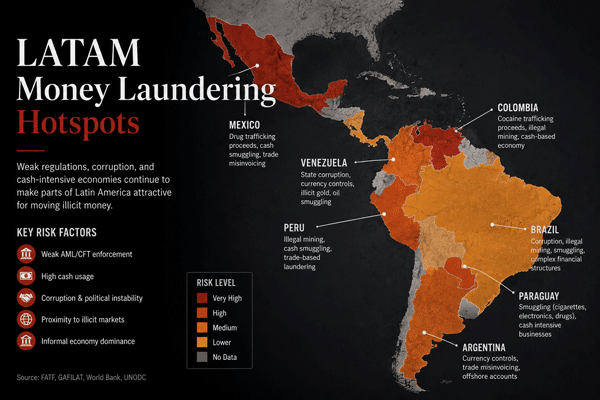
Governments know exactly what's happening. The excuses are bullshit: "Casinos are too complex", "Hard to prove intent", "Offshore is beyond jurisdiction". The real calculation (ITAR - Implicit Trade-Off): Tax revenue from casinos vs. cost of real enforcement + political risk + possible cartel retaliation. Decision: Collect taxes, look the other way. LATAM Regulatory Theater: Mexico's UIF files reports that go nowhere. Brazil's Central Bank watches illegal billions flow. Colombia's superintendency is outgunned by bribes.
The Cryptocurrency Angle (The Future Is Untraceable)
Crypto casinos are the money launderer's wet dream: no/low KYC on many platforms, irreversible transactions, privacy coins, darknet operation, speed measured in hours. Ransomware operators and cartels convert dirty crypto → play on Stake, 1xBet-style offshore sites → cash out through layered exchanges. Blockchain analysis only works if casinos and exchanges cooperate - most don't.
The Complicit Players (Everyone Profits Except the Public)
Casinos: Take 5-10% rake + laundering fees. No casino is "accidentally" facilitating this at scale - it's fucking profitable as fuck. Payment processors & crypto exchanges: Willful blindness. Affiliates & VPNs: Distribution and technical enablers. Government officials: Bribes to look the other way, regulatory capture, tax revenue addiction.
Real-World Impact (This Isn't Victimless)
What Would Actually Stop This? (Spoiler: Nothing Will)
Weak half-measures that exist: FATF guidelines (ignored), occasional sanctions, blockchain analysis that casinos can easily circumvent.
How to Spot Potential Laundering Activity
- Large cash deposits with minimal/no KYC
- Multiple small deposits by different people (structuring)
- Heavy betting followed by quick cash-out as "winnings"
- Frequent wires to/from offshore shell companies
- Use of privacy coins or multiple crypto exchanges
- "Too good to be true" win rates or patterns
- US: FinCEN (fincen.gov) or local FBI field office
- Mexico: UIF (Unidad de Inteligencia Financiera)
- Brazil: COAF (Conselho de Controle de Atividades Financeiras)
- Colombia: UIAF
- Argentina: UIF
- International: Interpol or local Financial Intelligence Unit
- US: FinCEN.gov
- Mexico: UIF (sat.gob.mx/uif)
- Brazil: COAF (bcb.gov.br)
- Colombia: UIAF
- International: Interpol.int
- FinCEN reports & findings
- Chainalysis crypto crime reports
- FATF money laundering typologies
- UNODC organized crime reports
- Milenio, Reforma, Animal Político (Mexico)
- Folha de S.Paulo, O Globo (Brazil)
- El Tiempo, RCN (Colombia)
- Clarín, La Nación (Argentina)

Former problem gambler turned responsible-gambling advocate. Psychology background; reviews only what she'd use with her own money.
LinkedInView profile →Disclaimer: This is investigative journalism based on public records, official findings (including FinCEN 2025), news investigations, and law enforcement reporting. It is not legal advice. Money laundering is a serious crime. If you have credible information about suspected laundering through gambling, report it to the appropriate authorities (FinCEN in the US, local Financial Intelligence Units in LATAM countries, or international bodies like Interpol). The house doesn't just win. The system launders the blood money that keeps the house running.