
I Make Money Promoting Casinos.
This Is How The Whole Thing Actually Works - From The Inside.
I need to be honest with you from the start. I've made money and currently make money promoting casinos. Not as some big flashy influencer with millions of followers, but as someone who understands the affiliate system inside and out. I've run TikTok accounts, built review sites, worked with networks, tested traffic sources, and seen exactly how the money moves from player losses all the way up to the people cashing out at the top.
- I've seen the real numbers. On good months when things scale properly, the top people in this ecosystem are clearing six and seven figures. Even solid mid-level operators running a few accounts or sites can pull $20k–$60k per month. That kind of money changes how you see things. It makes it easier to look away from the damage.
- These tactics work. That's why they're used so widely. I've justified it the same way most people in this space do - "They're adults, they can make their own choices," "It's just marketing," "If I don't do it, someone else will." But I've also seen the messages from people who lost money they couldn't afford after following links I helped promote. That part doesn't disappear just because I learned how to navigate my addiction and they have not.
- Most of us know exactly what we're doing. The people who claim they don't are usually lying to themselves or to you. The money is good enough that a lot of people are willing to look the other way on the ethics.
Why I'm Writing This
At the same time, I've watched what it does to people. I've seen the chats, the desperate messages, the people who lose rent money or get into serious debt because someone like me made gambling look easy, fun, or like a smart way to make money. That tension - making good money while knowing the damage - is why I'm writing this the way I am.
The Money Machine I'm Part Of
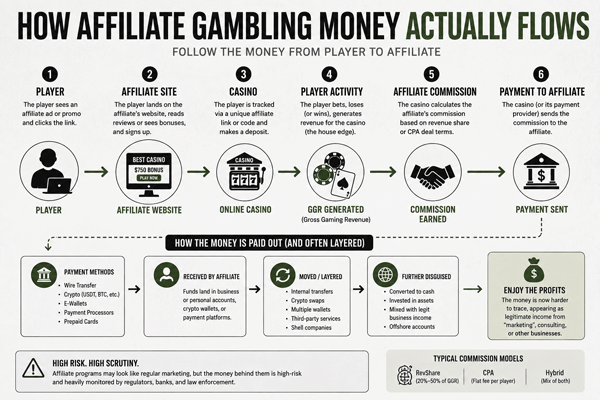
When I first got into affiliate marketing for casinos, I told myself the usual things people tell themselves. "It's just marketing." "People are adults, they can make their own decisions." "I'm not forcing anyone to click." Most people in this space say the exact same shit when they start.
Here's how the money actually flows through the system I've been part of:
- Casinos generate billions from player losses.
- They allocate 20-40% of that revenue to customer acquisition through affiliate programs because it's cheaper and often more effective than traditional advertising.
- Affiliate networks take their cut - usually 10-30% - for managing tracking, payments, and recruiting people like me.
- The rest gets distributed to affiliates based on signups, deposits, and player losses.
The brutal truth is that this model is more profitable for casinos than direct advertising for several reasons: they only pay when they get results, it's harder to regulate because it's distributed across thousands of people, and it feels more authentic to the audience than obvious corporate ads. When someone they follow or trust promotes a casino, conversion rates go way up. That's the whole game.
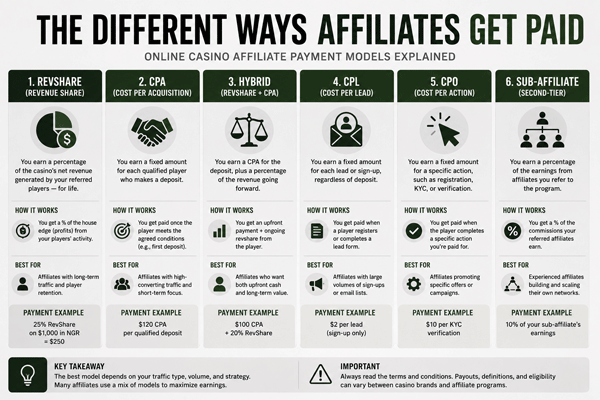
How I Actually Get Paid (The Different Models)
Where I Actually Send People (The Traffic Sources That Work)
I've tested pretty much every traffic source that exists in this space. Some work better than others depending on what you're good at and how much time you're willing to put in.
- TikTok (The Fastest Growth Channel) - The audience skews young (18-35), which means a lot of people who are gambling-naive but curious. The content that performs best is usually short "win" clips (real or edited), fake strategy videos, and reaction content. A decent video that gets decent reach can bring in hundreds of signups.
- YouTube (The More Sustainable Play) - Slower to grow but more stable. Casino "review" channels and strategy videos can rank for years through SEO. Channels with 100k subscribers can generate $2,000 to $20,000+ per month in affiliate commissions on top of YouTube ad revenue. Live gambling streams also convert extremely well.
- Google SEO and Review Sites (The Long Game) - Building review sites or networks of sites that rank for terms like "best casinos" can generate organic traffic for years. Once a site ranks, it keeps converting without you having to post new content every day. The conversion rates on SEO traffic are often higher because the person searching is already in "I want to gamble" mode.
What I Actually Did to Get People to Convert
This is the part most people in this space don't like talking about openly. The tactics that actually move conversion rates are often misleading or manipulative. I've used variations of some of them at different points:
- Fake win videos and edited screenshots that make it look like regular people are winning big
- Scarcity and urgency timers ("Bonus expires in 24 hours" or "Only X spots left")
- Fake testimonials and "player" screenshots using stock photos or paid actors
- Burying important information like wagering requirements and house edge
- "Risk-free" or "bet $100, get it back if you lose" offers that have massive hidden wagering requirements
- Creating FOMO by making it seem like "everyone is winning" so the viewer feels like they're missing out
How It Works in LATAM (Where I've Spent Most of My Time The Past Few Years)
How We Hide What We're Doing
Regulation in this space is weak in most places, which is why so many people stay in it. Here's how the game is usually played:
- Using cryptocurrency payments and shell companies to make it hard to trace where the money is coming from
- Creating multiple layers between the casino, the network, and the individual affiliate so responsibility is diffused
- Rotating domains and spinning content to stay ahead of platform bans and algorithm changes
- Using tiny or missing disclosure hashtags so the promotional nature isn't obvious to casual viewers
- Operating across multiple jurisdictions so no single regulator can easily shut down the entire operation
The Part I Can't Keep Ignoring
I'm making money doing this. I'm not going to pretend otherwise. I've also seen what it costs other people. I've seen the messages from people who lost money they needed. I've seen the patterns, the same demographics getting hit hardest, the same tactics working because people are desperate or young or don't fully understand what they're getting into.
The system is built so that the people at the top - the casinos, the big networks, and the top affiliates - make the most money while the people at the bottom, the actual players, lose the most. I've been somewhere in the middle of that chain for a while now.
Most people in this space will tell you it's just marketing and that players are responsible for their own choices. Some of that is true. But when you've been inside it long enough and seen the same outcomes repeat, it becomes harder to keep telling yourself it's neutral. The machine is working exactly as designed. I'm just done pretending I don't see it.
Red Flags of Affiliate Gambling Promotion
Printable Checklist
- Fake "win" videos or edited screenshots
- Scarcity/urgency timers ("Bonus expires soon")
- Fake testimonials or stock photo "players"
- Buried wagering requirements or house edge
- "Risk-free" offers with massive hidden requirements
- Tiny or missing #ad / #partner / #sponsored
- Crypto-only payments or shell company language
- Coordinated campaigns with identical language
- Report to platform trust & safety
- Report to local advertising standards body
- If targeting minors or vulnerable people: report to financial intelligence unit
- Unfollow and warn others in comments
- If gambling has hurt you: seek professional help immediately
Resources & Where to Get Help
- Platform Trust & Safety (TikTok, YouTube, Instagram, Twitch)
- Local advertising standards bodies
- Financial intelligence units (for crypto/shell payments)
- Gamblers Anonymous - local meetings worldwide
- National Council on Problem Gambling (US) or national equivalents
- Brazil: CVV (188) or SUS addiction services
- Mexico, Argentina, Chile, Peru: Local health ministries or addiction hotlines
- Consider the real cost to the people clicking your links
- The machine is working exactly as designed
- You can choose to look away - or stop pretending you don't see it

Former problem gambler turned responsible-gambling advocate. Psychology background; reviews only what she'd use with her own money.
LinkedInView profile →Disclaimer: This is written from direct experience inside the affiliate gambling world. It is not financial, legal, or business advice. If you're seeing coordinated promotion, hidden affiliate links, or aggressive targeting of young or vulnerable audiences, you're looking at this system in action. Report it where you can. And if gambling promoted this way has hurt you or someone you know, there are resources available through national problem gambling organizations. The machine is working exactly as designed. I'm just done pretending I don't see it.